Joo Chiat Heritage Walk Shophouses Food and Peranakan Stories
A walk through Singapore’s first Heritage Town
Joo Chiat rewards a slow pace. This east-coast neighbourhood was designated a conservation area by the Urban Redevelopment Authority on 23 July 1993, but its personality was shaped decades earlier by wealthy landowners, immigrant craftsmen and Peranakan families who built some of the most ornate shophouses in Singapore. In February 2011, the National Heritage Board named Joo Chiat the country’s first Heritage Town, formalising what residents and repeat visitors already knew: the streets here hold layers of architectural and culinary history that reward unhurried exploration.
A practical walking route threads through the conservation zone, linking pastel-coloured terrace houses, private museums, a historic Hindu temple and food stops that have anchored the neighbourhood for generations. The distances are short and the pavements flat, so the route works as a half-day stroll with pauses for food and browsing. Because several stops require advance booking or have variable hours, planning ahead is essential rather than optional.
Koon Seng Road and the Straits Eclectic terrace houses
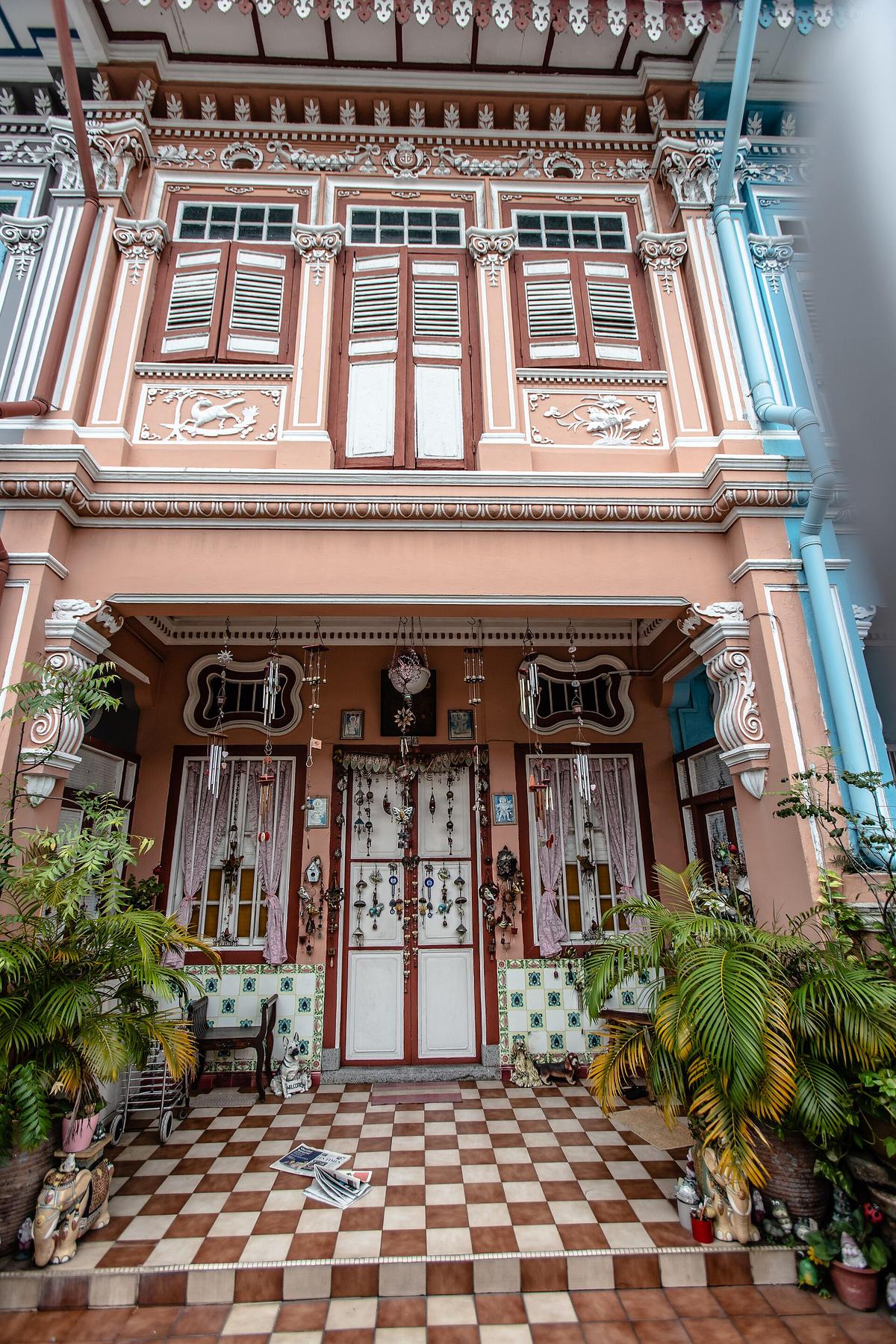
Begin on Koon Seng Road, a quiet residential stretch that holds some of the finest surviving examples of Straits Eclectic architecture in Singapore. The pastel-coloured pre-war terrace houses here were built in the 1920s and 1930s, blending Chinese, Malay and European design influences into a style that feels unmistakably local. Look for the ornamental plasterwork, Peranakan-style pintu pagar (swing doors) and glazed ceramic tiles decorating the façades. These details are not reproductions; they are original features protected under the conservation framework.
The road itself carries a story. It was renamed in 1934 after Cheong Koon Seng, a prominent auctioneer, Municipal Commissioner and Justice of the Peace who died that year. Before that, it was known simply as Lorong E East Coast. Standing here, you are looking at a street that the Urban Redevelopment Authority has singled out as architecturally significant, and the visual evidence makes the case without needing a guidebook.
Photography is possible from the public footpath, but these are private homes. Stepping onto the tiled forecourts without invitation is intrusive, so frame your shots from the road edge or opposite pavement.
East Coast Road and the Peranakan heritage stops
From Koon Seng Road, walk south to East Coast Road, the main artery of the conservation area. The neighbourhood is named after Chew Joo Chiat, a wealthy landowner and philanthropist known as the King of Katong, who bought large plots of land here in the early 20th century. His name now labels the district, and East Coast Road remains its commercial spine.
At 113 East Coast Road, Rumah Bebe occupies a 1928 shophouse and operates as a Peranakan heritage boutique and museum. Inside you can find beading workshops, kebaya costumes and handmade kasut manek, the intricately beaded slippers that are a hallmark of Nyonya craft. Whether the museum section is open and whether workshops are running depends on the day, so check the Rumah Bebe website before setting out.
A short walk east brings you to 208 East Coast Road, home to Katong Antique House. This private museum was founded by the late fourth-generation Peranakan Peter Wee and houses antiques dating back to the 1800s. Visits are by appointment only. The collection is personal and dense, and the experience depends on being shown around by someone who knows the pieces. To arrange a visit, call the number published by Katong Antique House directly; do not assume you can walk in.
Joo Chiat Place and a taste of Nyonya rice dumplings
Turn inland to Joo Chiat Place, where Kim Choo Kueh Chang has operated since 1945. This is an original Nyonya rice-dumpling maker, and its main factory sits at number 60. A branch also operates at 111 East Coast Road, so you have two options depending on your route. The dumplings, wrapped in bamboo leaves and filled with spiced pork or sweet bean paste, are a direct link to the Peranakan home-cooking tradition that defines the area’s food identity.
Opening hours and availability of specific dumpling varieties are not fixed across the year, particularly around festivals when production shifts to meet demand. The Kim Choo Kueh Chang website is the authoritative source for current information. As editorial advice, visiting the Joo Chiat Place factory rather than the East Coast Road branch gives you a stronger sense of the production scale, but the branch is more convenient if you are sticking to the main road.
Ceylon Road and Sri Senpaga Vinayagar Temple
A short detour north to 19 Ceylon Road brings you to Sri Senpaga Vinayagar Temple, which traces its origins to the 1850s. It is the second-oldest Hindu temple in Singapore, after Sri Mariamman Temple on South Bridge Road. The current building is not the original 19th-century structure, but the site’s continuous religious use across more than a century and a half makes it a significant layer in Joo Chiat’s multi-ethnic history.
The temple is dedicated to Vinayagar, the elephant-headed deity, and its architecture reflects South Indian Dravidian traditions. Visitors are welcome, but this is an active place of worship. Removing footwear before entering the inner halls is standard practice, and dressing modestly is respectful. The temple does not charge an entry fee, but specific opening hours for non-worshippers should be checked directly with the temple administration before visiting.
Joo Chiat Terrace and The Intan
Nearby at 69 Joo Chiat Terrace, The Intan is an award-winning private Peranakan home museum curated by owner Alvin Yapp. The collection exceeds 5,000 objects, ranging from furniture and ceramics to textiles and jewellery, all displayed inside a residential setting rather than a formal gallery. This domestic context is central to the experience: you are essentially a guest in someone’s home, surrounded by objects collected over decades.
Visits are strictly by appointment only. There is no walk-in option, and the booking process is managed through The Intan’s official website. The tradeoff is clear: the requirement to book ahead adds friction, but it also guarantees a guided, unhurried visit rather than a crowded browse. If you are serious about understanding Peranakan material culture, this is the stop worth scheduling your day around.
The guided alternative and how to choose
If you prefer a structured walk with a trained guide, the National Heritage Board runs a built-heritage walking tour called Stories in Stone through its Heritage Activation Node at Katong-Joo Chiat. The tour covers the Koon Seng Road Peranakan houses, the Red House Bakery and the Former Joo Chiat Police Station, connecting architectural details to the social history of the conservation area.
Tour dates, times and ticket prices are not fixed across the year. The National Heritage Board’s Roots.gov.sg portal is the authoritative source for the current schedule and booking instructions. Choosing between a self-guided walk and the official tour comes down to depth versus flexibility. The guided tour provides historical context that is hard to replicate on your own, but it runs on a set timetable. A self-guided walk lets you linger at the food stops and adjust your pace, but you will miss the narrative detail a guide provides. Doing both on different visits is a reasonable ambition if the neighbourhood interests you.
Practical notes for a smooth walk
The conservation area is compact, and the route described here can be walked in a few hours at a comfortable pace. Start in the morning when the light on Koon Seng Road is best for photography and when food stops are freshly stocked. The Urban Redevelopment Authority gazetted 518 buildings in Joo Chiat for conservation in 1991, mainly two-storey shophouses and terrace houses of the Transitional, Late and Art Deco styles, so the architectural interest is not confined to a single street. Wandering the side lanes between the main stops often reveals details you would miss on a direct route.
Because The Intan and Katong Antique House require appointments, and Rumah Bebe’s workshop schedule varies, the single most important planning step is confirming availability before you travel. Contact each venue through its official channels. The same applies to the Stories in Stone tour. None of these details can be reliably printed in a durable article, and assuming they remain static will lead to disappointment.
- Conservation status:
- Heritage Town designation:
- Area namesake:
- Architectural highlight:
- Oldest Hindu temple in the area:
Sources and verification
- ura.gov.sg — Research source checked for this guide
- sg101.gov.sg — Research source checked for this guide
- nlb.gov.sg — Research source checked for this guide
- roots.gov.sg — Research source checked for this guide
- ura.gov.sg — Research source checked for this guide
- edb.gov.sg — Research source checked for this guide