Singapore Trades That Disappeared From the Five Foot Way
The corridor that held a thousand livelihoods
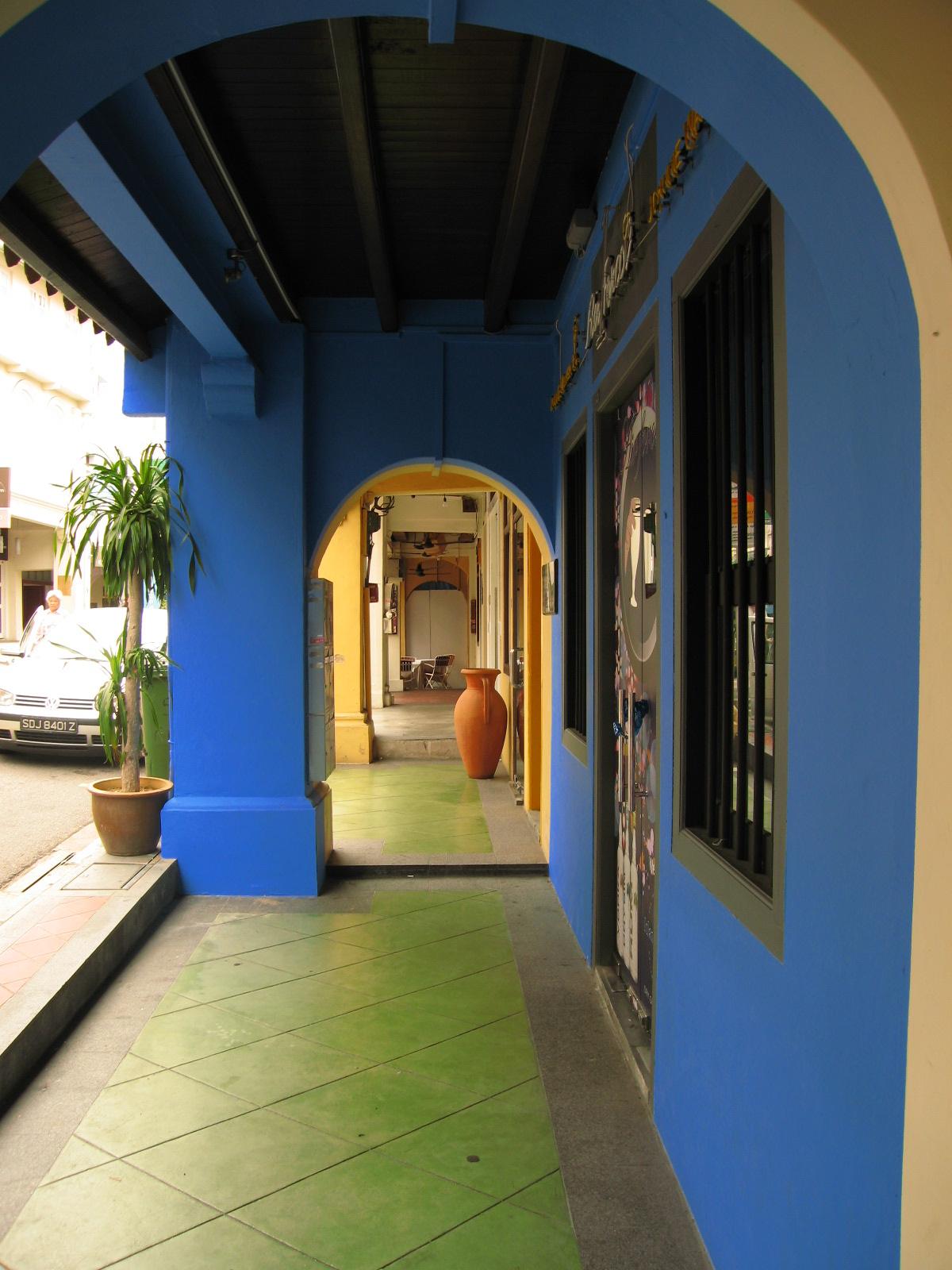
Walk through any conserved shophouse district in Singapore today and the covered pedestrian arcade at the front feels like a thoughtful piece of tropical architecture, a respite from equatorial sun and sudden downpours. That arcade is the five-foot way, and its existence is no accident. Sir Stamford Raffles mandated these covered walkways in his early building plans for colonial Singapore, insisting that every shophouse provide a sheltered passage for pedestrians. What began as a town-planning rule became something far richer: a strip of economic life where some of the island's most intimate and peculiar trades took root.
The Hokkien-speaking community called these enterprises gho kha ki, literally "five-foot-way" trades. The name captured both the physical constraint and the resourcefulness required. Within a space barely wide enough for two people to pass comfortably, a man could sharpen your knives, write a letter home to China, tell your fortune with a parrot, or sell you a cone of roasted nuts wrapped in newspaper. These were not marginal curiosities. They were the services that kept a migrant society functioning, and their practitioners were overwhelmingly immigrants from China, India and Southeast Asia who arrived from the late nineteenth to early twentieth centuries and could not find work elsewhere.
Who worked the five-foot way
The range of documented trades is startling. Knife sharpeners carried portable grinding wheels and announced their presence with a distinctive call. Street barbers set up mirrors against shophouse walls and offered shaves and haircuts in the open air. Mask makers, fortune tellers, locksmiths and letter writers all staked their claims to small sections of the walkway. Traditional medicine men, known as bomoh, dispensed remedies alongside newspaper vendors and storytellers who recited epic tales for a listening crowd. Tinsmiths hammered out household items, hair-bun makers served women who still wore elaborate traditional styles, and stool makers assembled simple furniture within arm's reach of passing traffic. Garland makers strung flowers for temple offerings, stamp dealers traded in tiny squares of paper, and food vendors cooked and served from carts wedged into the narrow corridor. Cobblers repaired shoes, kachang puteh sellers scooped boiled and flavoured nuts into paper cones, and ice-ball sellers shaved blocks of ice and drenched the resulting spheres in coloured syrup. Parrot astrologers kept green birds that would pick fortune cards from a deck, while snake charmers brought a flicker of danger to the sheltered walkway.
These were not static professions. Some trades were completely obliterated when demand collapsed. Charcoal dealers vanished as gas and electric cooking spread. Craftsmen who made paper bags, hair buns, daching or beam scales, wooden barrels, stools and masks found their skills rendered obsolete by industrial production and changing fashions. The five-foot way had always been a marketplace of necessity, and when the necessity disappeared, so did the trade.
The great relocation and its consequences
The 1980s and 1990s brought a transformation that proved terminal for many cottage industries. Shophouses were demolished in large numbers, and the itinerant peddlers who had operated from the five-foot way were relocated to flatted factories. What looked like a move toward formality carried hidden costs. Overheads increased sharply once a trader had to pay factory rent rather than occupy a sliver of public walkway. Anti-pollution regulations, sensible in intent, made it harder to run small-scale operations that produced smoke, noise or waste. Perhaps most decisively, the trades struggled to find younger workers willing to learn skills that promised long hours and modest returns. A knife sharpener or a stool maker could not easily compete with the salaries and air-conditioned comfort of office jobs in a rapidly modernising economy.
By the mid-1970s, some five-foot-way trades had already disappeared. A few professions adapted and continued in a modern setting, but the arcade as a dense ecosystem of micro-enterprise was fading. The covered walkway remained, but the voices that had filled it, the calls of vendors and the tap of the cobbler's hammer, grew quieter.
Voices preserved in the archive
What we know of these vanished trades comes substantially from a deliberate effort to record them before they were lost. The Oral History Centre of the National Archives of Singapore was established in 1979, and its interviewers went out to find the men and women who had worked the five-foot way. The recorded interviews document the granular realities of these lives: why someone entered a trade, what the remuneration was like, who the customers were, how the business was conducted day to day, and how training and apprenticeship worked when knowledge passed from master to helper without a textbook in sight.
In 1992, the Oral History Department published Vanishing Trades: A Catalogue of Oral History Interviews, which summarised conversations with 112 people from more than 70 different trades. Among them were five-foot-way traders including the cobbler, the fortune teller, the kacang putih seller and the letter writer cum calligrapher. That same year saw the publication of Vanishing Trades of Singapore, edited by Lo-Ang Siew Ghim and Chua Chee Huan, which drew on the oral history collection to profile 20 vanishing trades. The book covers the letter writer, the parrot astrologer and the snake charmer, among others, and remains a key reference for anyone trying to understand what was lost.
These oral histories are not just nostalgic exercises. They capture practical knowledge, social relationships and economic structures that written records often miss. A letter writer's account of his fees and clientele reveals literacy rates and migration patterns. A fortune teller's description of his customers shows what anxieties preoccupied a community. The archive preserves the texture of working lives that would otherwise be reduced to a sentence in a history textbook.
A brief revival and what survives
In December 2011, the National Heritage Board ran a project called "Heritage Along Footpaths" that brought a number of five-foot-way trades back to the arcades. Street barbers, ice-ball sellers, kachang puteh sellers, cobblers and fortune tellers set up once more, offering their wares and services at prices from an earlier era. It was a curated revival, not a spontaneous return, and it demonstrated both the public appetite for these memories and the impossibility of restoring the original ecosystem. A festival could bring back the sights and sounds for a short while, but the economic and social conditions that had sustained the trades were gone.
A few five-foot-way trades have survived into the present day, though their numbers continue to dwindle. The mobile ice-cream cart vendor, selling blocks of ice cream wrapped in colourful bread, remains a familiar sight outside schools and in housing estates. Roadside cobblers still operate in a few locations, repairing shoes and bags with tools that have barely changed in decades. Traditional bakeries and provision shops persist, and the occasional shoe-last maker can still be found. These survivors are the exceptions, and their presence should not obscure the scale of what disappeared. The five-foot way as a dense, noisy, inventive strip of micro-commerce is a memory, not a living reality.
How to explore the oral history record
Anyone who wants to hear the voices of former five-foot-way traders can turn to the National Archives of Singapore, which holds the oral history collection. Access to the recordings may require permission, and current policies on listening to interviews should be checked directly with the Oral History Centre before planning a visit. The archive's online catalogue provides descriptions of many interviews, which can help researchers identify relevant recordings before making any access request.
For those interested in whether any traditional five-foot-way traders are still operating at known locations, such as the kachang puteh seller formerly at Peace Centre on Selegie Road or fortune tellers around Waterloo Street, the National Heritage Board is the appropriate authority to consult. The survival of individual traders is not guaranteed, and a location that appears in older publications may no longer be active. Checking with the Board before making a trip is a practical step that avoids disappointment.
Sources and verification
- nlb.gov.sg — Research source checked for this guide
- biblioasia.nlb.gov.sg — Research source checked for this guide
- nlb.gov.sg — Research source checked for this guide
- nhb.gov.sg — Research source checked for this guide
- nas.gov.sg — Research source checked for this guide